

Buying in Leander? Check the Pool First.
There's a particular kind of optimism that kicks in the moment you fall in love with a house. The kitchen's a little small, sure. The master bath is stuck in 1993. But that backyard — that backyard has pool written all over it. You can already see it: the water glittering in the July heat, kids cannonballing off the side, a cold drink sweating on the ledge. You're sold.
Then reality shows up. And in Leander, reality comes with a survey, a setback chart, and a permit application that lives on the city's website.
Here's the thing — none of this has to be a dealbreaker. It just has to be something you know about before you close. Buying a home with pool dreams and finding out afterward that the lot can't support it is the kind of mistake that hurts in a very specific, preventable way. This guide exists so that doesn't happen to you.
STEP ONE
Start With the Survey
Before anything else — before you call a pool builder, before you sketch out where the tanning ledge goes — you need to get your hands on the survey for any property you're seriously considering. A good survey is basically a map of what you can and can't do with your land, and two things on it will matter enormously for your pool plans.
Build Lines
Build lines mark the boundary inside which your structures have to live. The good news: a pool and its surrounding hardscape (think decking, coping, patio) can be built within the build line. What can't? Anything that rises above the height of your fence. So if you're picturing a dramatic pergola over the water, a detached cabana, or a cascading waterfall that rivals something out of a Sedona resort, those will need to live elsewhere on the lot.
Public Utility Easements (P.U.E.)
This is the one that catches people off guard. A Public Utility Easement is a strip of your property that utility companies have the right to access. Nothing permanent can be built in a P.U.E. — and "permanent" absolutely includes a pool. If a portion of your ideal pool footprint falls inside a P.U.E., you have a decision to make.
It's not impossible to work around. You can get written releases from every utility provider with infrastructure on your property — water, electric, gas, telecom, the works — and then have a new survey drafted that formally removes the easement. But that process takes time, coordination, and money. Know about it before you're under contract, not after.
STEP TWO
The Septic Question
In the older and more rural pockets of Cedar Park and Leander, a fair number of properties are still on private septic systems rather than city sewer. If the home you're eyeing has one, you need to know about it — because a septic system creates a web of setback requirements that directly affects where your pool can go.
These rules fall under OSSF — On-Site Sewage Facilities — regulations, and they're not suggestions. Here's how the numbers break down:
On a generous lot, ten or fifteen feet is manageable. On a tighter parcel where the septic system takes up a meaningful chunk of the usable space, these setbacks can reduce your buildable zone considerably. Get the septic location mapped out early and overlay it mentally against where you're imagining the pool. If it doesn't add up, it's better to know now.
STEP THREE
When You'll Need an Engineer?
Think of the engineer requirement not as a bureaucratic hurdle but as a built-in protection. Pools built in tight proximity to foundations or on dramatic grade changes are exactly where you want someone doing the math. And if the lot you're considering has significant slope to it, which is not uncommon in the Hill Country-adjacent terrain around these two cities — it's worth getting an early assessment on whether your design vision will require that engineering layer.
Under 2021 ISPSC standards (the International Swimming Pool and Spa Code, which is what Cedar Park and Leander follow), certain pool configurations trigger an engineer requirement. Specifically, you'll need a licensed engineer on the project if either of these conditions apply:
ENGINEER REQUIRED IF?
POOL WALL EXCEEDS 24" ABOVE GRADE
If any wall of the pool rises more than two feet above the surrounding ground level — think elevated pools on sloped lots or raised infinity-edge designs — you'll need engineered plans.
WATERLINE IS WITHIN 5 FEET OF HOUSE FOUNDATION
Pool water and foundations have a complicated relationship. If you're building close to the house, an engineer ensures the structural integrity of both. This protects you long-term.
STEP FOUR
Impervious Cover : This Is One Less Thing to Worry About
Here's a piece of genuinely good news: Leander currently impose no city-level impervious cover restrictions specific to pool construction. Impervious cover refers to any surface that doesn't allow water to drain into the ground , concrete, stone decking, the pool shell itself , and in many Texas municipalities this can be a limiting factor in how much hardscape you're allowed to install.
That said, if your property falls within an HOA, a planned development with deed restrictions, or a specific watershed protection overlay, separate limitations may apply. Always worth a quick check. But at the city level? You've got room to build the deck of your dreams.
STEP FIVE
The Permit: Your Official Green Light
Once you own the home and you're ready to move forward, the permit is your formal entry point into the construction process. For Leander, permit applications are submitted through:
PERMIT APPLICATION PORTAL FOR LEANDER - www.leandertx.gov/hubgo
This is where you'll initiate theprocess, upload plans, and track approvals. Cedar Park applicants should verify current submission requirements through the City of Cedar Park's Development Services department, as portals and procedures can be updated.
Your Pre-Purchase Pool Checklist
The Central Texas market moves fast. Homes that check all these boxes don't wait around, and neither do the ones that look perfect until you pull the survey. Going into the process informed is what separates the buyers who end up with the pool of their dreams from the ones who end up explaining to their family why the backyard is just... a backyard.
Before you put in an offer on any home you're planning to build a pool at, run through this list. Print it. Screenshot it. Send it to your realtor.
✓ REQUEST THE PROPERTY SURVEY
Locate build lines and any P.U.E. boundaries. Confirm the pool footprint doesn't fall inside a utility easement.
✓ DETERMINE SEWER VS. SEPTIC
If on septic (OSSF), identify tank, line, leach field, and system type. Map setback requirements against your intended pool placement.
✓ ASSESS THE GRADE OF THE LOT
Significant slope may trigger the 24"-above-grade engineer requirement. Know what you're working with before design begins.
✓ MEASURE DISTANCE FROM PROPOSED POOL TO FOUNDATION
If your ideal placement puts the waterline within 5 feet of the home's foundation, budget for and plan around the engineer requirement.
✓ CHECK FOR HOA OR DEED RESTRICTIONS
City-level impervious cover is unrestricted, but your HOA or development CC&Rs may have their own rules. Read them before you plan.
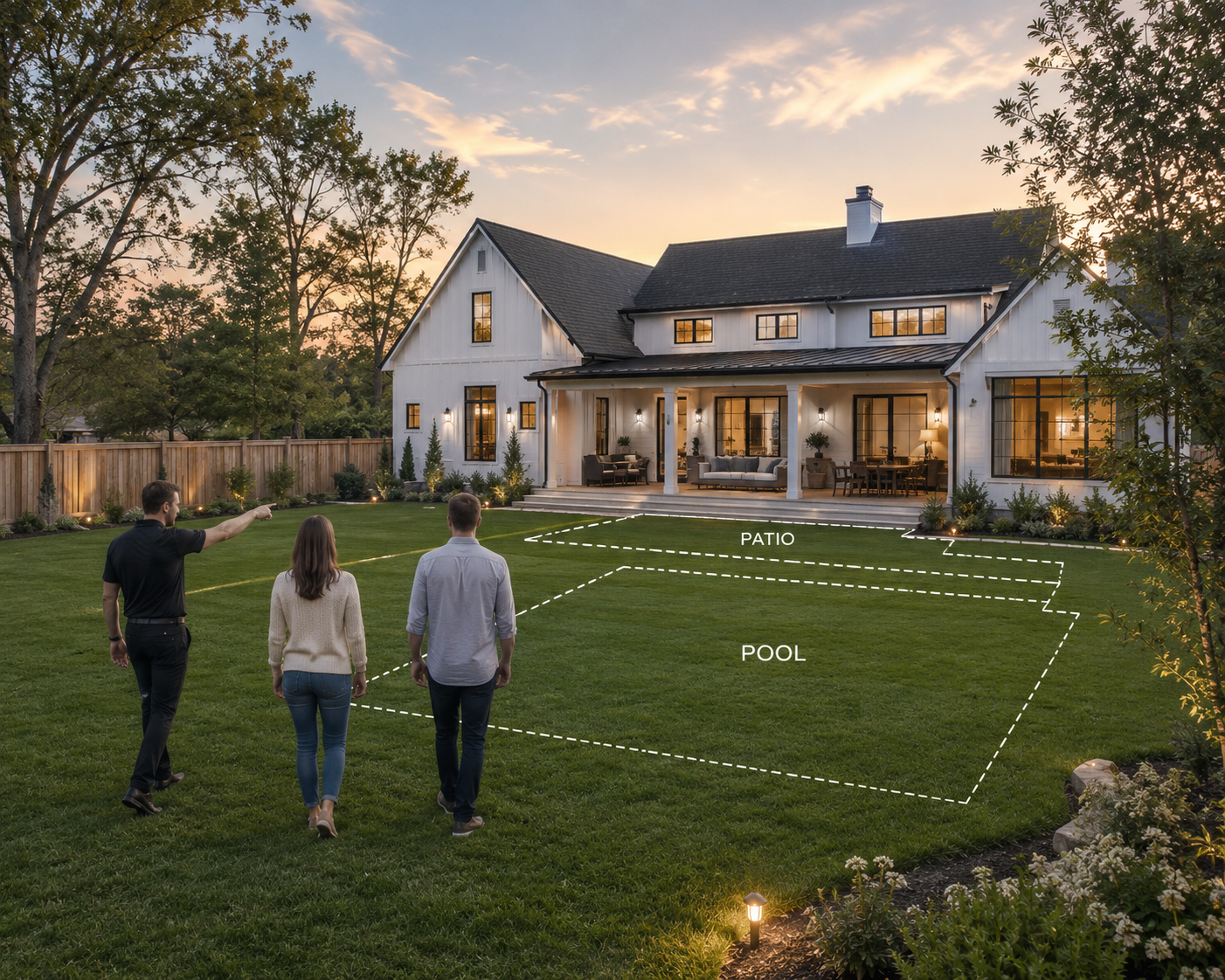
✓ HAVE US WALK THE LOT WITH YOU
Before closing, if possible, bring a qualified pool contractor to walk the property with you. A good builder can spot issues, and opportunities, that most buyers miss.
✓ CONFIRM STRUCTURES WITHIN BUILD LINE
Pergolas, casitas, or tall water features must clear the fence height limit to be built within the B.L. Plan feature heights accordingly.