

Why Is the Lueders Stone Around My Pool Chipping and Falling Apart?
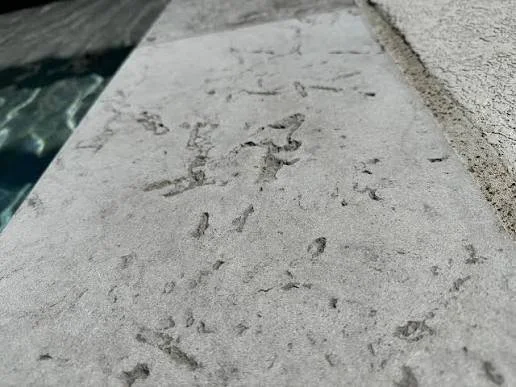
You walk outside after a Central Texas winter and notice something new around your pool. A small chip in the coping. Then another. Maybe one of your Lueders stones has a pit that seems bigger than you remember, or the surface has started flaking off in thin layers.
The first thought is usually: Is something wrong with my pool? Not necessarily.
Lueders is a natural stone, and some chipping, pitting and deterioration can happen over time. Around a swimming pool, that stone also has a pretty tough job. It's constantly exposed to water, pool chemicals, sun, rain and the occasional Texas freeze.
Here's what's actually happening, what you can do about it and when it's time to replace the stone.
First, Remember That Lueders Is a Natural Stone
Lueders isn't a manufactured product where every piece comes out exactly the same.
It's natural limestone cut from the earth.
That's part of what makes it look so good, but it also means every piece is a little different. One stone may be extremely dense while another has a small pocket, soft spot, layer or natural void that isn't even noticeable when it's installed.
That doesn't necessarily mean you received a bad piece of stone or that something was installed incorrectly.
Most of the time, you won't think twice about it.
Then Texas weather gets involved.
What Freezing Weather Does to Lueders
Imagine there's already a tiny natural pocket in the stone.
It rains and water settles into that area.
Then the temperature drops below freezing.
The water freezes and expands.
When it warms back up, the ice melts. The next rain gives water another opportunity to enter the area, and another freeze can expand it again.
Rain. Freeze. Thaw. Repeat.
Over time, what started as a tiny imperfection can become a noticeable pit or chip.
That's why homeowners sometimes walk outside after a hard Central Texas freeze and suddenly notice damage they swear wasn't there before.
The freeze may not have created the original pocket.
It found it.
Your Pool Water Doesn't Make Life Any Easier
Weather isn't the only thing Lueders has to deal with.
Think about what happens every time somebody gets out of the pool.
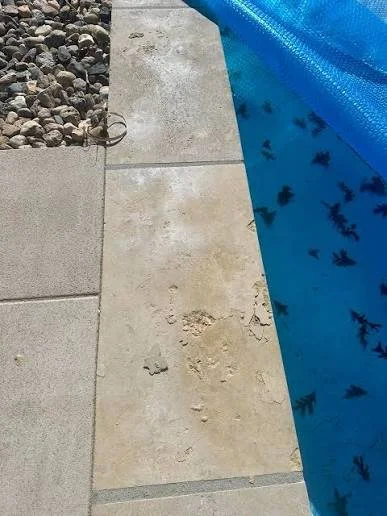
Pool water gets splashed onto the coping and deck, then sits there and eventually evaporates. Depending on your pool and water chemistry, that water can leave behind salts, minerals and chemical residue.
Do that thousands of times over the life of a pool and you're asking a natural, porous material to deal with a pretty harsh environment.
That's why one of the easiest things you can do is also one of the most overlooked:
Rinse your coping and deck with fresh water.
If everybody has been swimming and there's been a lot of pool water splashed around, giving the area a quick rinse can help wash away residue instead of allowing it to repeatedly dry on the stone.
It's simple maintenance, but natural stone generally benefits from a little extra care.
A Stone Sealer Can Help
Another option worth considering is a quality sealer designed specifically for natural stone and pool environments.
A sealer isn't going to make Lueders indestructible.
It isn't going to stop every chip.
And it isn't going to fix a piece that's already deteriorating.
What it can do is help reduce how readily moisture and contaminants penetrate the surface.
The important thing is using the right product for the specific stone. You don't want to grab a random sealer from the hardware store and coat your pool coping with it. Some products can change the appearance of natural stone or create other problems around a wet pool environment.
If you're unsure, ask the stone supplier or a professional which penetrating sealer is appropriate for your particular Lueders.
Blue Lueders Can Behave a Little Differently
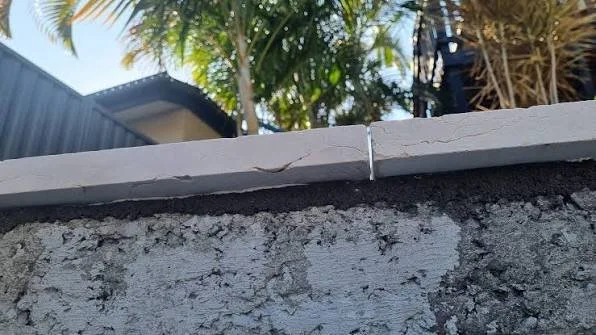
If you have the darker gray stone commonly called Blue Lueders, you may notice a different type of deterioration.
Instead of developing only a small pit, pieces of the surface can sometimes begin separating or chipping away in layers.
It can almost look like slate peeling apart.
Again, we're talking about natural stone.
Blue Lueders can have natural layers and variations within it, and occasionally one of those layers will begin separating. Moisture and repeated weather exposure can make it more noticeable over time.
It doesn't automatically mean your pool is failing.
And it doesn't automatically mean somebody installed the stone incorrectly.
Sometimes it's simply natural stone being natural stone.
What About Those Little Voids Between the Stones?
Sometimes the problem isn't actually the Lueders itself.
You may notice small areas or joints around the coping where material has washed out or a void has developed.
Depending on the location and how the coping was originally installed, polymeric sand may sometimes be useful for filling certain joints or small voids.
But be careful here.
Polymeric sand isn't something you want smeared across your Lueders and allowed to set on the surface.
The coping needs to be clean before you start, excess material needs to be completely removed from the stone, and the product needs to be appropriate for the particular joint you're trying to repair.
If you're not sure what the void is or why it appeared, don't just fill it.
A missing joint and movement underneath the coping are two completely different problems.
Can You Repair Chipped Lueders?
Sometimes.
If we're dealing with a small surface imperfection, we may be able to sand or buff the stone and make the damaged area much less noticeable.
That's always worth looking at before tearing something out.
But there's a limit.
If a piece has started pitting deeply, losing larger sections or separating in layers, sanding isn't going to put the missing stone back.
At some point, you're trying to save something that really just needs to be replaced.
Usually the best solution at that point is simple:
Remove the damaged piece and install a new piece of Lueders.
And if only one or two pieces are affected, that doesn't mean you need to replace the coping around the entire pool.
What If It Keeps Happening?
Now we're having a different conversation.
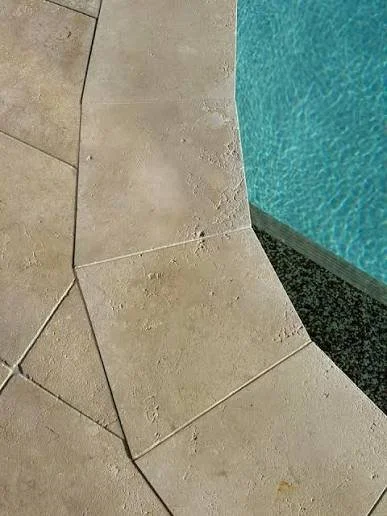
Replacing an occasional damaged piece is one thing.
Walking around the pool and finding deterioration everywhere is another.
If you're already planning a larger pool remodel, that's when we start asking whether it makes sense to put the exact same material back.
You can absolutely replace the existing coping with new Lueders.
But you can also use the opportunity to change the look completely.
Maybe It's Time for Marble or Travertine
We use Lueders because it can look fantastic around a swimming pool. We're not going to tell you it's a bad product simply because natural stone can occasionally have imperfections.
But it isn't your only option.
If you're already removing the coping as part of a remodel, marble or travertine may be worth considering.
And don't automatically choose a material just because that's what was there before.
Look at the house.
Look at your decking.
Look at the new tile and plaster you're considering.
Then decide what actually belongs in the backyard you're creating today.
One More Thing: Make Sure It's Actually the Stone
This is important.
There's a big difference between one piece of natural stone developing a pit and multiple pieces of coping cracking, shifting or separating because something underneath them is moving.
If we're seeing unusual cracking throughout the coping, movement around the bond beam, cracked tile, movement around the spa or other signs of structural problems, we want to understand what's causing it before replacing everything.
Especially with the ASR issues we've been seeing in Central Texas pools, covering a potentially larger problem with brand-new coping isn't the answer.
Sometimes it's just the stone.
Sometimes it's what's underneath it.
Knowing the difference can save you from spending a lot of money fixing the wrong problem.
So, Is Chipping Lueders Normal?
To an extent, yes.
It's natural stone sitting outside in one of the tougher environments you can give it.
Texas sun. Rain. Pool water. Chemicals. Wet and dry cycles. And then every once in a while, a hard freeze.
Small imperfections are going to happen.
Keep the stone clean. Rinse the coping and deck after heavy pool use. Consider an appropriate natural stone sealer. Keep an eye on small pits and chips before they become bigger ones.
If a piece becomes too deteriorated, replace it.
And if you're seeing widespread cracking or movement rather than normal surface deterioration, have somebody take a closer look before assuming the coping is the problem.
Austin Dreamscapes remodels and renovates swimming pools throughout Austin and the surrounding Central Texas area. Whether it's replacing a couple pieces of damaged Lueders or completely changing the coping, tile, plaster and surrounding backyard, the goal is the same:
Fix what actually needs fixing instead of covering it up.