

Cracking From the Inside
If you've found cracking around your pool's shell, steps, or coping and someone's mentioned "concrete cancer," you're probably hoping there's a simpler fix than tearing the whole thing out. We get it, a full pool removal sounds extreme.
Here's the honest answer: for a pool with true ASR, there isn't a simpler fix. Below is what that reaction actually does to a pool, why patching doesn't solve it, and what to expect if you end up going the removal route.
A quick refresher on what ASR actually is
Alkali-silica reaction (ASR) the thing people mean when they say "concrete cancer" is a slow chemical reaction between certain reactive aggregates in the concrete mix and the alkalis in cement. As that reaction runs, it forms a gel inside the concrete that absorbs water and expands. The expansion cracks the concrete from the inside out.
That's the part that makes it so different from ordinary settling cracks or a bad patch job: the damage isn't sitting on the surface. It's happening inside the material itself, and it keeps happening as long as moisture and the reactive aggregate are both present which, in a pool, is basically forever.
Can you patch a pool with concrete cancer?
No. You can put a band-aid on it surface patches, resurfacing, crack injection and those will make the pool look better and might even hold for a season or two. But none of them are a long-term fix, because none of them stop the reaction happening inside the concrete. The gel keeps expanding, new cracks keep forming (often right next to the old patch), and the shell keeps slowly breaking down underneath whatever's been applied to the surface.
Sadly, once ASR has taken hold, there are really only two long-term paths:
❌ Demo the pool and start over — remove the affected shell completely and rebuild with a mix and process that controls for ASR from the start.
❌Demo the pool and fill in the hole — if you've decided you don't want a pool there anymore, removing the shell and properly backfilling the space is the other legitimate long-term option.
What removal actually looks like
If you go the demo route, here's roughly what the process involves:
Assessment first. Before anything gets torn out, a good contractor will confirm it's actually ASR (not just settling or a bad original pour) and take a look at the surrounding decking, plumbing, and equipment pad to figure out how much of the project extends beyond just the shell itself.
Permits and utility locates. Pool demolition typically requires a permit, and any gas, electrical, or plumbing lines running to equipment need to be located and safely disconnected or capped before equipment shows up.
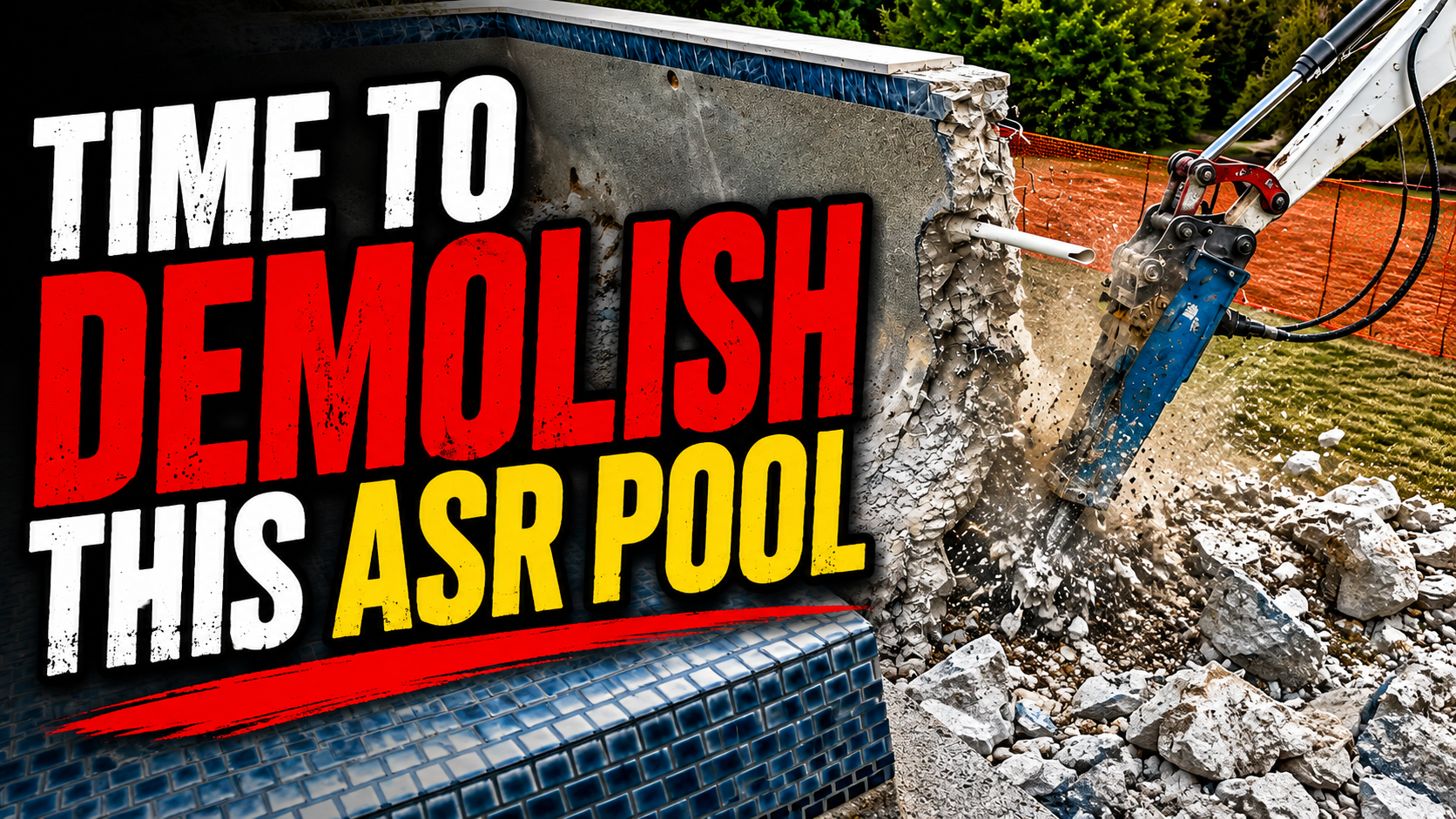
The actual demo. This is the loud, messy part — heavy equipment (usually an excavator with a hydraulic breaker) breaks up the gunite or concrete shell, and the debris gets loaded out. Depending on your yard's access, this can mean equipment coming through a gate or, in tighter lots, over a fence section that gets removed and rebuilt afterward.
Backfill or rebuild prep. If you're filling the hole in for good, the site gets properly backfilled and compacted in layers so the ground doesn't settle unevenly later this step matters more than people expect, since poor backfill just creates a new problem in the yard. If you're rebuilding, this is also where the new excavation and engineering for the replacement pool begins.
Site cleanup. Once the concrete and debris are hauled off, what's left is either graded, level ground ready for landscaping, or a fresh excavation ready for the new build.
Expect noise, some yard disruption beyond just the pool footprint, and a timeline that depends heavily on the size of the pool and how easy your yard is for equipment to access.
Be careful with builders who claim they've "never had a case of ASR"
More and more builders are advertising that they've never had a pool with ASR. Sometimes that's a fair, verifiable claim. Other times, it's harder to check than it sounds, and worth understanding why before you take it at face value.
Here's the pattern that been showing up in this industry: when a company closes and reopens under a new name or a new LLC, that new entity's track record technically starts from zero, even if the people actually building the pools didn't change. Something similar can happen at the individual level, a builder might describe past ASR issues as belonging to "the company I used to work for," even if they were the one on site making the calls at the time. In situations like these, "we've never had a case of ASR" can be technically true and still not tell you much about what to actually expect from that team going forward.
None of this means every builder who makes the claim is doing so to dodge accountability, It just means the claim alone isn't something a homeowner can easily verify, so it's worth asking a few follow-up questions rather than taking it at face value.
A few questions worth asking any builder who tells you they've never had a case of ASR:
How long has this specific company or LLC been building pools under its current name?
Have you, or your current leadership, built pools under a different business name before this one?
How many pools have you built using shotcrete? If so who supplied those mixes?
Can you show me your shotcrete mix design and how you test aggregate for ASR risk?
Would you put "Zero ASR" in writing in the contract?
How many Pools did you build from 2018-2022? Did any of those pool have any issues?
A company that's confident in its actual track record generally won't mind being asked these, the answers just help you tell a verifiable record apart from a fresh start.
A few more questions we hear from people
How do I know if it's actually ASR and not just a normal crack? Normal settling cracks tend to be straight-ish and isolated. ASR cracking often shows up as a map-like pattern of fine cracks (sometimes called "map cracking"), and it may come with discoloration, gel deposits in the cracks, or the surface popping/spalling in spots. If you're not sure, it's worth having someone knowledgeable actually look at it in person before deciding on a plan.
Is it dangerous to keep swimming in a pool with ASR? It's less about immediate danger and more about the fact that the structure is degrading over time. It's worth having the shell evaluated so you know how much time you realistically have before cracking or movement becomes a bigger problem.
If I fill the hole in, is that actually a permanent fix? Yes, as long as the shell is fully removed (not just capped or buried in place) and the backfill is done correctly. Burying a cracked shell without removing it isn't a real fix; the concrete is still there, still degrading, and can still cause the ground above it to settle unevenly down the road.
Do I have to rebuild with the same builder who caused the problem? No. If ASR shows up in a pool, that's exactly the kind of thing that comes down to how the original concrete was mixed and poured — which is why we control the mix, aggregate, and cure on every job. You're free to rebuild with whoever you trust, and it's worth asking directly what they do differently to prevent ASR from happening again.
If your pool is showing signs of trouble, don’t wait until the damage gets worse. call us (512)883-POOL to learn more, or call us today to schedule an inspection. Let's get you the confidence you deserve in your builder.